VanshVriksh — Family Graph
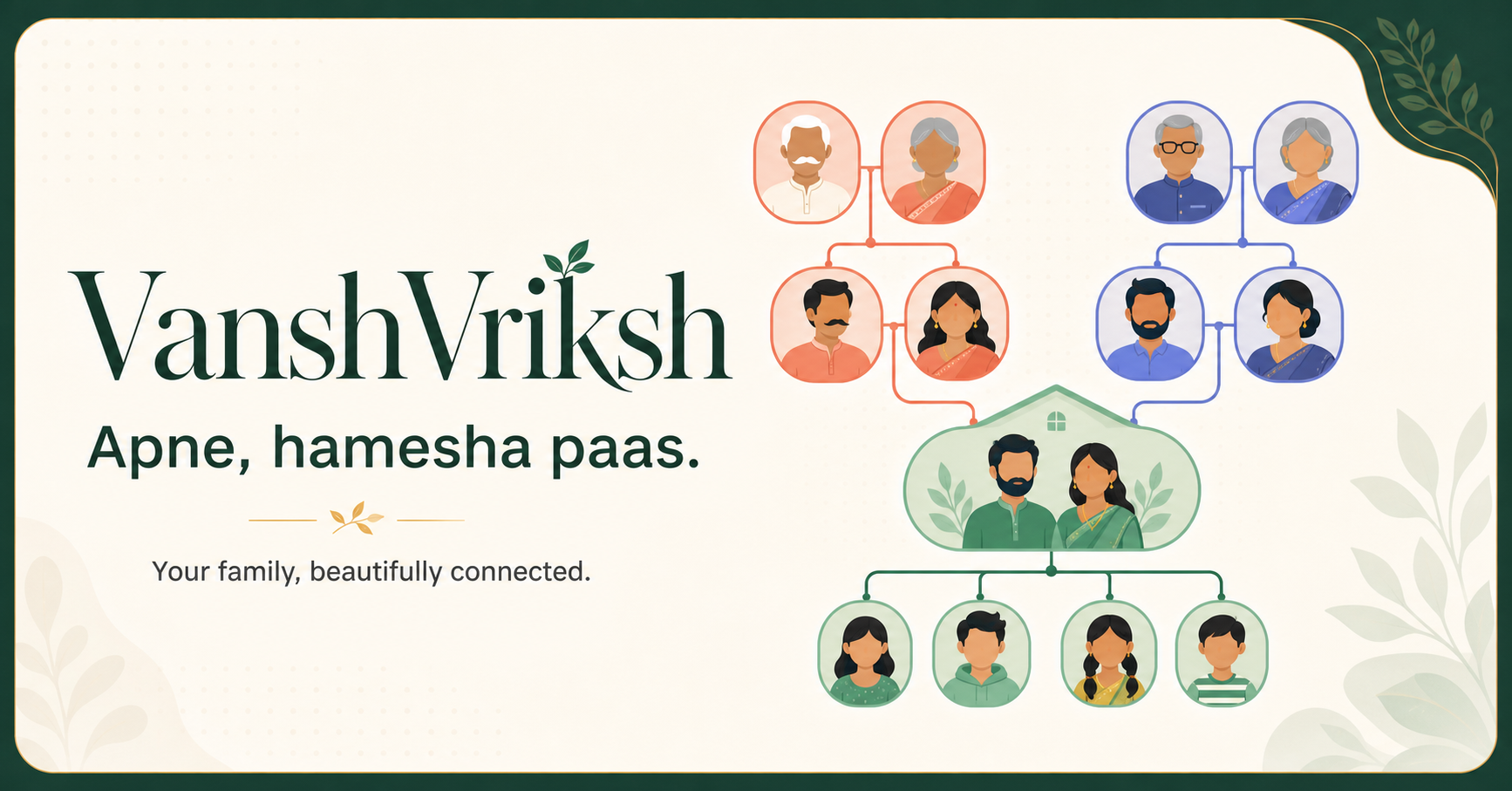
An India-first, privacy-first living family graph that helps large families see their hierarchy, understand relationships, add relatives in seconds, and stay connected across generations. The tree is the main interface: people can create and claim profiles, link families through marriage, select groups such as father’s-side cousins, keep private notes, remember family moments, and safely review possible duplicate profiles.
- Status
- Product concept
- Role
- Product engineering
- Focus
- Application
Product capabilities
What it helps people do
- Tree-first hierarchy with contextual parent, spouse, sibling, child, and relative creation
- Viewer-relative relationship groups with explainable graph traversal
- Phone OTP profile verification, ownership, and visible trust states
- Human-reviewed duplicate detection and reversible profile merges
- Marriage-linked family graphs with independent privacy boundaries
- Profiles with biographies, metadata, portfolio links, social profiles, and field-level visibility
- Author-only private notes that never transfer through profile claims or merges
- Birthday, anniversary, festival, call, message, and invitation actions
- Color-coded family labels, newsletters, and selective group gift planning
- India-first phone flows, multilingual architecture, low-bandwidth design, and accessible graph views
System architecture
One canonical family graph. Many private points of view.
Neo4j is authoritative for the family graph: every human is one Person node and every family connection is a typed edge. A separate relational security store owns accounts, claims, permissions, encrypted contacts, private notes, audit, and workflows.
Canonical graph
Neo4j stores canonical Person nodes and parent, partner, guardian, adoption, and historical marriage edges. Individual tree layouts remain user-specific views rather than copied family data.
Identity and profile claims
An account is not automatically a person. OTP verification proves control of a contact point; an invitation and explicit profile claim establish ownership or stewardship.
Relationship query engine
Bounded, permission-aware Cypher traversal answers how two people are related, resolves dynamic groups such as all cousins on the viewer’s father’s side, and returns an explanation path.
Separate spouse nodes
A couple is never one database record. Each spouse is an independent Person node joined by one SPOUSE_OF edge; the interface positions the two nodes together.
Safe merge workflow
Names, contact hashes, dates, locations, and relationship overlap create duplicate candidates. Authorized people review evidence before a transactional, audited, and reversible merge.
Event-driven family moments
Queues isolate invitations, OTP delivery, reminders, newsletters, duplicate evaluation, and future gift fulfillment from interactive graph writes.
Privacy boundaries
Graph access, profile-field visibility, contact details, private notes, blocks, and relationship disputes are evaluated on the server. Marriage can connect traversal without silently sharing two families’ private data.
Skills required
Product architecture for a deeply human graph.
Graph and domain modeling
Designing Neo4j Person nodes, typed relationship edges, Cypher traversal, viewer-relative kinship, automatic layout, saved perspectives, and explainable paths at family scale.
Identity, privacy, and abuse prevention
Separating accounts from people, securing phone OTP, protecting minors and memorial profiles, enforcing field visibility, and preventing contact discovery or invitation abuse.
India-first product design
Phone-first and WhatsApp-friendly flows, regional family terms, Unicode and locale readiness, low-bandwidth Android performance, festivals, and large multi-generational family structures.
Distributed workflow design
Idempotent writes, event queues, provider reconciliation, notification preferences, audit trails, and safe failure handling for reminders, invitations, newsletters, and gifts.
Delivery approach
Earn the right to expand beyond the tree.
- 01
Validate the tree-first add experience with Indian family coordinators and finalize relationship, stewardship, language, and privacy rules.
- 02
Ship a private tree MVP with fast relative creation, profiles, invitations, saved roots, private notes, and birthday or anniversary reminders.
- 03
Add marriage-linked graphs, relationship groups, branch labels, duplicate review, and reversible merges after graph trust is proven.
- 04
Layer in WhatsApp-friendly communication, family moments, and consent-safe newsletter drafting.
- 05
Introduce reviewed group gift planning and one fulfillment partner only after recipient selection and privacy workflows are reliable.
Product guardrails
Family trust is more important than graph completeness.
- A phone OTP proves contact control, not automatic identity, profile ownership, or access to a private family tree.
- The product never silently merges people or grants access to another family because of marriage.
- Private notes belong only to their author and are excluded from claims, merges, newsletters, and exports.
- Dynamic relationship groups must explain why each person was included and allow manual exclusion before messaging, gifting, or exporting.
- Sensitive classifications such as caste, religion, health, and finances are not default profile fields.
- The graph must have a keyboard-accessible list alternative and remain usable on mid-range Android devices and Indian 4G networks.
REQUEST A DEMO
Want to see VanshVriksh — Family Graph in context?
Share what you would like to explore.
Sign in to like or comment.